
Jimmy Lai sentenced to 20 years in Hong Kong security case as global press freedom concerns deepen
Hong Kong has sentenced Apple Daily founder Jimmy Lai to 20 years in prison on national security and sedition-related charges. Rights groups and international observers say the landmark case deepens fears that journalism, political speech and overseas advocacy are being redefined as criminal threats under Beijing’s post-2020 security framework.
5 min read
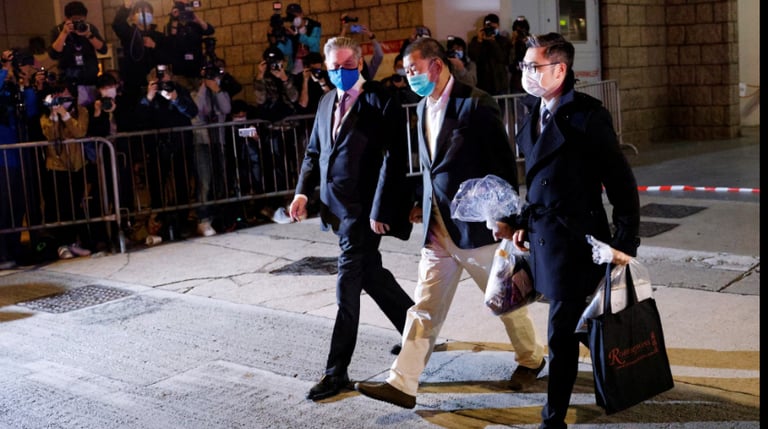
Jimmy Lai sentenced to 20 years in Hong Kong security case as global press freedom concerns deepen
Hong Kong | 9 February 2026 — A Hong Kong court has sentenced publisher and pro-democracy figure Jimmy Lai to a total of 20 years in prison, in the most internationally scrutinised national security case Hong Kong has pursued since Beijing imposed the National Security Law (NSL) in 2020. Lai, 78, founded the now-shuttered newspaper Apple Daily, and the sentence is being widely interpreted by press freedom advocates as a defining moment in the city’s rapid transformation from a relatively open media hub into a far tighter political and journalistic environment.
Lai was convicted in December 2025 and sentenced today on charges that include two counts of conspiracy to collude with foreign forces and a further offence linked to publishing “seditious” materials. Prosecutors and authorities say the case concerns national security rather than journalism; critics argue the prosecution collapses the boundary between political speech, international advocacy and press activity — and will intensify self-censorship across Hong Kong’s remaining independent outlets.
Who Jimmy Lai is — and why this case became symbolic
Jimmy Lai is not simply a media owner caught up in a political dispute. He became one of the most recognisable faces of Hong Kong’s pro-democracy movement after 2019’s mass protests and Beijing’s decision to impose the NSL in June 2020. Reuters has described him as a long-time China critic and a central figure in the post-2020 legal clampdown, with his prosecution becoming a flagship case for the NSL’s most serious “foreign collusion” allegations.
Lai’s newspaper, Apple Daily, was known for its populist style and fierce criticism of Chinese and Hong Kong authorities. Its closure in 2021 — following raids, arrests of senior figures and the freezing of assets — has been repeatedly cited by international observers as a watershed for media pluralism in Hong Kong. Reuters reporting from 2021 documented the financial and operational impact of the government’s asset freezes and the paper’s warning that it could not survive without access to funds.
That history matters because press freedom organisations argue the “risk model” for newsrooms shifted: enforcement can now be existential, not just legal — a point sharpened by Apple Daily’s collapse and the way the NSL enables asset restrictions that can strangle operations.
What the court decided
According to Reuters, Lai’s total 20-year sentence combines punishment for multiple offences, with the court treating him as a central organiser in the alleged conspiracies. The convictions include conspiracy to collude with foreign forces — a national security offence carrying severe penalties — and a conviction tied to publishing “seditious” materials.
Associated Press reported the court described Lai as the “mastermind” behind the alleged conspiracies and said the ruling represents the longest sentence handed down under Hong Kong’s national security law to date. AP also noted the court took account of Lai’s age and health in its sentencing approach, while still imposing an unusually heavy term.
For press freedom advocates, the headline isn’t only the number of years — it’s what that number communicates. A long sentence imposed on a high-profile publisher sends a deterrent message across the media sector, particularly where editorial lines intersect with political critique or international engagement.
The heart of the dispute: “national security” versus “journalism”
Hong Kong and Chinese authorities insist NSL prosecutions do not target legitimate reporting, arguing that “journalism is not a shield” for conduct that endangers national security. This official framing has been consistent across NSL cases: the state’s position is that the law is about stability and security, not press freedom.
Critics counter that the categories used in NSL prosecutions — particularly “foreign collusion” — can overlap with journalism-adjacent behaviour:
maintaining contacts with overseas politicians and institutions,
advocating internationally on rights issues,
publishing commentary that encourages foreign pressure,
or commissioning opinion pieces that challenge the state.
Where those activities can be reframed as “collusion”, press freedom organisations warn that the line between protected expression and criminality becomes dangerously elastic — and media owners and editors will rationally narrow what they publish to avoid risk.
This is one reason the Lai case has been watched globally: it tests whether a publishing model that is outspoken, political and international-facing can still exist in Hong Kong under the NSL — or whether only low-risk, carefully bounded journalism can survive.
Apple Daily’s closure and the mechanics of pressure
Even before today’s sentence, the broader crackdown on Apple Daily shaped international perceptions of Hong Kong’s media trajectory.
Reuters’ contemporaneous reporting in 2021 described how the government froze assets linked to Lai and his company Next Digital, creating an immediate liquidity crisis. Apple Daily publicly warned it only had cash for a limited time after assets were frozen, and the paper shut down shortly afterwards.
Al Jazeera’s reporting from the same period described the asset freeze as a major escalation, highlighting how financial measures — not only prosecutions — can be used against media entities under the security framework.
Press freedom advocates argue these tools intensify the chilling effect because they raise the costs of resistance: a newsroom does not need to lose a trial to be destroyed; it can be rendered non-functional long before legal proceedings reach their end.
International reaction
Today’s sentence drew condemnation and concern from multiple international actors. AP reported reaction from foreign leaders and rights groups, portraying the case as politically motivated and as a blow to civil liberties and judicial independence in Hong Kong.
The UK government issued a statement condemning the outcome and describing Lai as a British national, but global reaction has not been limited to any one country; the case has become a symbol in wider debates over the NSL’s impact, Hong Kong’s autonomy, and the future of open civic space in the city.
Australian and regional coverage likewise framed the ruling as a landmark, noting that rights groups have described the sentence as effectively a “death sentence” given Lai’s age and the length of imprisonment.
Why this matters beyond Hong Kong
This case has become a reference point for a broader global trend: governments increasingly using expansive national security frameworks to control information, intimidate journalists, and restrict civil society — while insisting such actions are about safety rather than speech.
What makes Hong Kong distinct is the speed and scale of the transformation. For decades, the city functioned as a regional hub for international media — in part because it operated with legal norms, press practices, and civic freedoms that differed sharply from mainland China. Press freedom indices and watchdog assessments have since described a steep deterioration, with many outlets closing, relocating, or altering coverage due to legal risk.
The Lai case, therefore, is being watched as an indicator of what remains possible. If a globally known publisher can be sentenced to 20 years under security charges linked to speech and advocacy, the question for editors and reporters is not theoretical: it becomes a day-to-day calculation of whether a story is worth the potential consequences.
What happens next
Legally, Lai’s options now narrow into appeals and the long process of challenging convictions under an NSL environment where courts have consistently treated national security cases as exceptional. Reuters described this as Hong Kong’s most high-profile national security prosecution to date, underscoring its precedential weight.
Politically, the case is likely to remain a diplomatic flashpoint. And for the press freedom community, its significance will be measured in downstream effects: whether journalists become more cautious, whether remaining independent outlets soften their editorial stance, and whether international media continue to treat Hong Kong as a viable base for regional reporting.
Contact
Subscribe to our newsletter
© 2002 - 2026. All rights reserved.